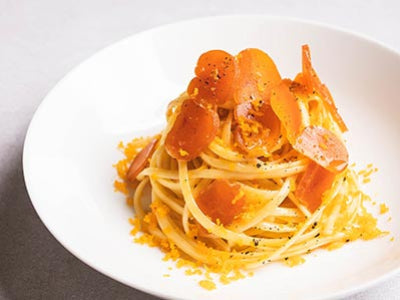


Discover the recipe for spaghetti with poutargue, a pasta dish reimagined by the chefs of the Prunier restaurant by Yannick Alléno.
Poutargue (or "bottarga"), also known as the "caviar of the Mediterranean", is a delicacy prized for its intensely briny flavor and beautiful orange color that adds color to your plates.
Here, the chefs have paired poutargue with fresh mussels, crunchy fennel, and fragrant shallots to create a unique and truly delicious combination of flavors.
Follow our step-by-step guide to prepare this essential seafood dish, a Mediterranean cuisine classic that is delicious all year round.
Per person:
Ingredients:
- Pasta: 100 g (one serving) We recommend linguine, but tagliatelle, penne, or spaghetti will also work very well.
- Prunier mullet poutargue: 20 g (about 2 tablespoons of grated poutargue + a few slices for garnish)
- Mussels: 200 g (about 2 cups)
- Fennel: about 1/4 of a small bulb
- Shallots: 1 small shallot
- Parsley: 1 tablespoon, chopped
- White wine: 50 ml (about 1/4 cup)
- Salt and pepper
Preparation:
1. Cooking: Cook the linguine in a large volume of salted water until al dente (about 10 minutes).
2. Clean the mussels by rinsing them under cold water and removing the beards.
3. Thinly slice the fennel and shallots. In a large pan, heat a little olive oil over medium heat. Add the sliced shallots and fennel. Sauté until tender.
Add the mussels to the pan, then pour in the white wine. Cover and cook until the mussels open (about 5 minutes). Discard any mussels that do not open.
4. Drain the cooked spaghetti and add them to the pan with the mussels.
5. For Serving: Using a ladle, place a generous portion of pasta and the mussel sauce in a shallow bowl, grate the poutargue over the pasta, and mix well. Add a few very thinly sliced pieces.
Sprinkle the dish with chopped parsley just before serving. You can also add a little Parmesan or even crème fraîche to the garnish, depending on your preference. Don't forget to season with salt and pepper.
Would you like to recreate this quick and easy recipe at home?
Discover our Prunier Poutargue available online on our website and delivered to your home within 24 hours (business days).
Made in France, it is prepared from mullet roe, then covered with a layer of wax for optimal preservation.
- - - - - - - - - - - - - - - - - - - - - - - - - - - - - - - - - - - - - - - - - - - - - - - - - - - - - - - - - - - - - - - - - - - - - - - -
Poutargue: a brief history and the origins of a gastronomic treasure
Poutargue is a gastronomic specialty made from salted and dried mullet roe. Renowned for its intense, briny flavor, it delights seafood lovers around the world. But what are the origins of this unique culinary specialty?
An Ancient Mediterranean History
The history of poutargue dates back several millennia. It goes back to ancient Egypt, where fishermen on the Nile had the habit of salting and drying fish eggs to preserve them for longer. The technique was then adopted and perfected by the Phoenicians, and later spread throughout the Mediterranean basin.
During the Roman Empire, poutargue was already considered an exceptional delicacy.
The Romans, who particularly appreciated it, included it in their feasts and banquets.
Over time, the recipe became firmly established in various countries such as Italy, Spain, and France.
A Tradition Preserved in Provence
In France, poutargue even became a specialty in the Martigues region, located in Provence.
Over the centuries, this small Mediterranean port became a major center for artisanal poutargue production. Thanks to its climate and the quality of the mullet fished in the Étang de Berre, the tradition became firmly rooted in local culture.
Poutargue production follows a rigorous process. After fishing, the roe sacs are carefully extracted, salted, pressed, and then dried for several weeks. This artisanal method gives poutargue its unique flavor and melt-in-the-mouth texture.
International Renown
Although poutargue remains an iconic product of Provençal cuisine, it is also highly prized in Italy (bottarga), Spain, Tunisia, and even Japan. Today, it graces the finest gastronomic tables and is used to enhance pasta, risotto, and fish carpaccio.
This culinary treasure, a legacy of ancestral expertise, continues to fascinate and delight gourmets around the world.
Poutargue is much more than a simple delicacy; it is a true expression of Mediterranean heritage, an exceptional product to be savored with gusto.